You're Holding It Wrong
What the iPhone Teaches Us About Healthcare

“Listen up, everyone…we have iPhones, and we’re locking the doors!”
It’s early summer 2008, and I face an existential technophile crisis: walk out of the store with my newly purchased Motorola RAZR or exchange it for the freshly released iPhone 3G. Inventory was scarce with no way to predict when or where more phones would surface.
I had a rare chance to secure one.
As a lifelong tech enthusiast, I was intrigued by the iPhone, but not completely sold. To be honest, I found the original iPhone, launched a year prior, underwhelming. Compared to PalmPilots and BlackBerrys, the touch interface was novel and elegant.
But the screen was small with a somewhat grainy resolution. At that time, there was no App Store. Browsing to real websites on the device was cool at first, but quickly became frustrating. Websites were slow to load and few were optimized for mobile browsers.
Who wanted to text someone when it was much easier to just call them?
The iPhone 3G solved some of these issues by adding faster cellular speeds and launching alongside the App Store. While the RAZR felt cutting edge, the iPhone 3G still felt like a beta product. Faced with a snap decision, I passed.
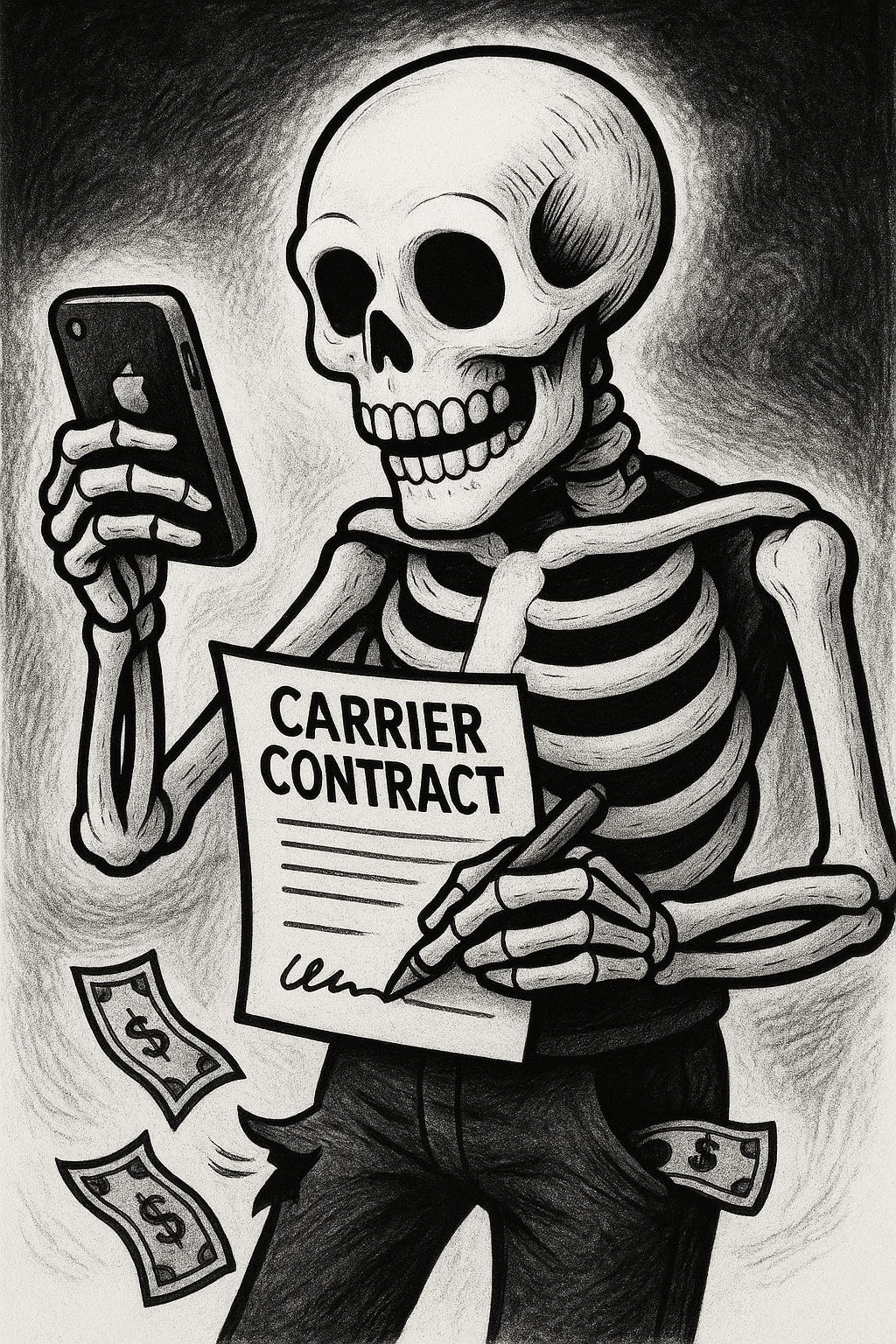
It didn’t take long for technophilia to get the best of me. I traded in my RAZR for the 3G a couple weeks later. I was shocked to discover that this coveted, state-of-the-art technology was only going to cost me $200. All I had to do was agree to a new two-year wireless contract — a service I needed anyway.
As it turns out, the iPhone 3G introduced another important, but less obvious innovation: carrier subsidies. In those early, unproven days, the iPhone was exclusive to AT&T. The company was quietly paying Apple hundreds of dollars per device, then baking the cost into the monthly plan. The full price of the phone was hidden, spread out over the length of the contract such that it seemed like a steal.
Buying an iPhone became a no-brainer at the point of sale.
But that sense of affordability normalized higher total costs and a perpetual two-year upgrade lock-in cycle. What started as a clever business plan to lower the barrier to entry morphed into what remains an opaque process marred by principal-agent problems, misaligned incentives, confusing purchase options, and limited networks.
Today, buying a cellphone parallels another painful consumer process: signing up for health insurance.
Open Enrollment and the Great Deflection
It’s open enrollment season — the time of year when the health insurance water gets a little hotter for us boiling frogs. For an average, middle-income family of four, employer-sponsored health coverage consumes about 10% of their annual income.
Signing up for benefits, especially health insurance coverage, is one of the most consequential financial decisions of the year.
But in the moment, it doesn’t feel that way. Instead, it feels like a responsible, necessary financial decision to protect ourselves and our families. We make an election, gain peace of mind that we’re covered, and forget about it until we need care. Meanwhile, premium dollars quietly disappear from your paycheck before they ever reach our bank accounts.
Automatic deductions and direct deposits mean we don’t miss what we never had. Employer match may feel like free money, but it’s not.
When we do need care, copays, coinsurance, deductibles, and HSAs blend together in a haze of complex coverage and indecipherable EOBs. We feel the acute pain of repeated paper cuts at the point of care. The deeper pain of rising costs is less tangible, abstracted by the open enrollment process; a chronic ache we’ve grudgingly learned to accept — because we have to.
And that’s largely by design.
The Bait and Switch
Like most smart business models, smartphone subsidies evolved over time. Not only did we get the shiny new device, we also got some things we didn’t necessarily bargain for.
For those early generation iPhones, AT&T exclusivity made switching carriers impossible. When that exclusivity ended, SIM cards and carrier-specific phones created network lock-in. Data overages became hidden costs that punished utilization. Throttled network speeds reduced accessibility. Suddenly, we had to think twice before using our devices. Eventually, we either accepted these limitations or, in many cases, realized that convenience meant tradeoffs — familiar frustrations beat the uncertainty of starting over.
Most of us shrugged and signed another 2-year contract.
Healthcare has its own version of overages, throttling, and locked devices. High deductibles, out-of-network penalties, and PBM markups punish people for using the system they already pay for. Prior authorizations, long wait times, and referral loops create frustration and throttle access. Narrow networks and employer-based coverage reduce choice and raise switching costs. When you do switch (i.e., change jobs), continuity is lost and costs are re-incurred.
Despite the endless bait-and-switch, we keep coming back for more, unable to escape the cycle.
From Novelty to Necessity
Early smartphones felt like a novelty. As an early adopter, I was quite proud of my early generation iPhone. However, few people remember that the technology was not an immediate hit, even with the rollout of the App Store and adoption of 3G wireless. At the time, BlackBerrys and PalmPilots were more popular and widely accepted.
I distinctly remember being scoffed at for owning an iPhone.
Of course, it wasn’t long before novelty turned into necessity. What began as a curiosity and luxury item quickly became its own form of insurance — societal insurance. Though the smartphone revolution probably would have happened anyway, we’re now dependent on these devices. Subsidy and opacity helped get us hooked and painted us into a corner.
Maybe our current health insurance system was inevitable too. But, like smartphones, it wasn’t always intended to be this way.
Originally voluntary and limited in scope, programs of the late 1800s and early 1900s focused on protecting income rather than paying medical expenses. Things changed during WWII-era inflation. Employer-sponsored insurance became a way to attract and retain employees whose wages were frozen. The tax exemptions didn’t hurt either. Once again, novelty became necessity.
Eighty-five years later, we’re now hooked. The kicker? It happened so gradually, we barely even noticed.
Today, true costs are disguised, and the employer subsidy drives dependency on an increasingly broken system. That dependency, so difficult to unwind, is why the system is so hard to change. It simply tightens its grip a little more each year and dares us to find a better way.
Instead of rationalizing the squeeze, how do we find an escape route?
The Out
Though I was a little slower on the uptake than I’d like to admit, it finally dawned on me to ask “why?” Why would a wireless carrier offer me the latest and greatest technology at a steeply discounted price? The phone was useless without the network — the contract was a mere formality. Of course, if you can’t figure out who the mark is, you’re the mark.
When it came to my cellphone contract, I was the mark and I needed an out.
In the world of smartphones, “the out” came in the form of an unlocked device. No contracts, subsidies, or locked down networks. Paying the full price was more expensive upfront but bought freedom to choose my carrier, plan, and upgrade cycle.
I learned to treat the phone as an asset to be protected — put it in a case (prevention), keep it updated (maintenance), and spring for AppleCare+ (value-add catastrophic coverage).
Of course, not everyone wants, needs, or can afford the flagship device with all the bells and whistles. But not everyone needs the most expensive option. A $400 unlocked Android on Mint Mobile for $25/month does 80% of what a subsidized iPhone on Verizon does. Half the total cost, none of the lock-in.
Lower-cost options are available for those who need something reliable — both on the hardware and the network side. Many offer comparable features and performance to their higher-cost counterparts at a fraction of the price.
Healthcare could benefit from similar lessons. Some would argue it already is.
Using direct contracting, reference-based pricing, and steerage to high-quality providers, employers can dramatically reduce costs while improving outcomes. No more prescriptive networks or obfuscated costs.
The goal should be transparency, control, and access with a focus on care rather than confusion. “Carrier” should be chosen based on quality and cost, not a limited menu provided through your employer’s HR portal. The one-two punch of paycheck drag and point-of-care nickel-and-diming simply isn’t sustainable.
A direct primary care membership runs $75–150 per month. Risk-bearing specialty care contracts with high-value providers can cut costs by 50% or more without sacrificing quality.
Compare that to the $800–1,200 per month (employer plus employee share) that disappears from an employee’s total compensation for a PPO plan they’re often afraid to use because of the deductible. The “affordable” subsidized option is frequently the most expensive one — you just can’t see the full price tag.
The infrastructure for high-value care exists, and major employers are quietly adopting these models. Demand-side willingness is catching up.
Of course, one size doesn’t fit all, and these solutions shouldn’t be romanticized as panaceas. The uncomfortable truth is that we’re likely moving toward a two-tiered system (whether we acknowledge it or not.) Unwinding the ESHI tax-exemption presents its own major conundrum. On top of that, there’s equally pressing need to address rural health accessibility, government-sponsored insurance, and regulatory barriers.
But over half of the population has employer-sponsored health. Momentum for change is growing faster in this segment of the healthcare market than others. Given where we are today, building on that momentum is paramount.
Once a viable way out exists, momentum will take care of the rest.
Conclusion
I really wanted an iPhone 4. The Retina Display. The redesigned form factor. The front-facing camera. FaceTime. For a relatively small upfront payment and renewed two-year contract, the feat of engineering was mine.
To this day, the iPhone 4 remains my favorite iteration of the iconic device. But it had one small flaw — “Antennagate.” Holding the phone in a certain way would block the antenna and cause calls to drop. Steve Jobs famously responded by telling customers they were “holding it wrong.” Eventually, Apple offered free bumper cases, a tacit admission that consumers were, in fact, not holding it wrong.
Every system has its own Antennagate moment.
Maybe we’re holding health insurance wrong. Or maybe, like the iPhone 4, the flaw isn’t in how we hold it, but in how it was built.
Ben Schwartz, MD, MBA
Editor-in-Chief, The Surgeon’s Record
SVP, Care Services & Strategy
ben@commonsclinic.com