

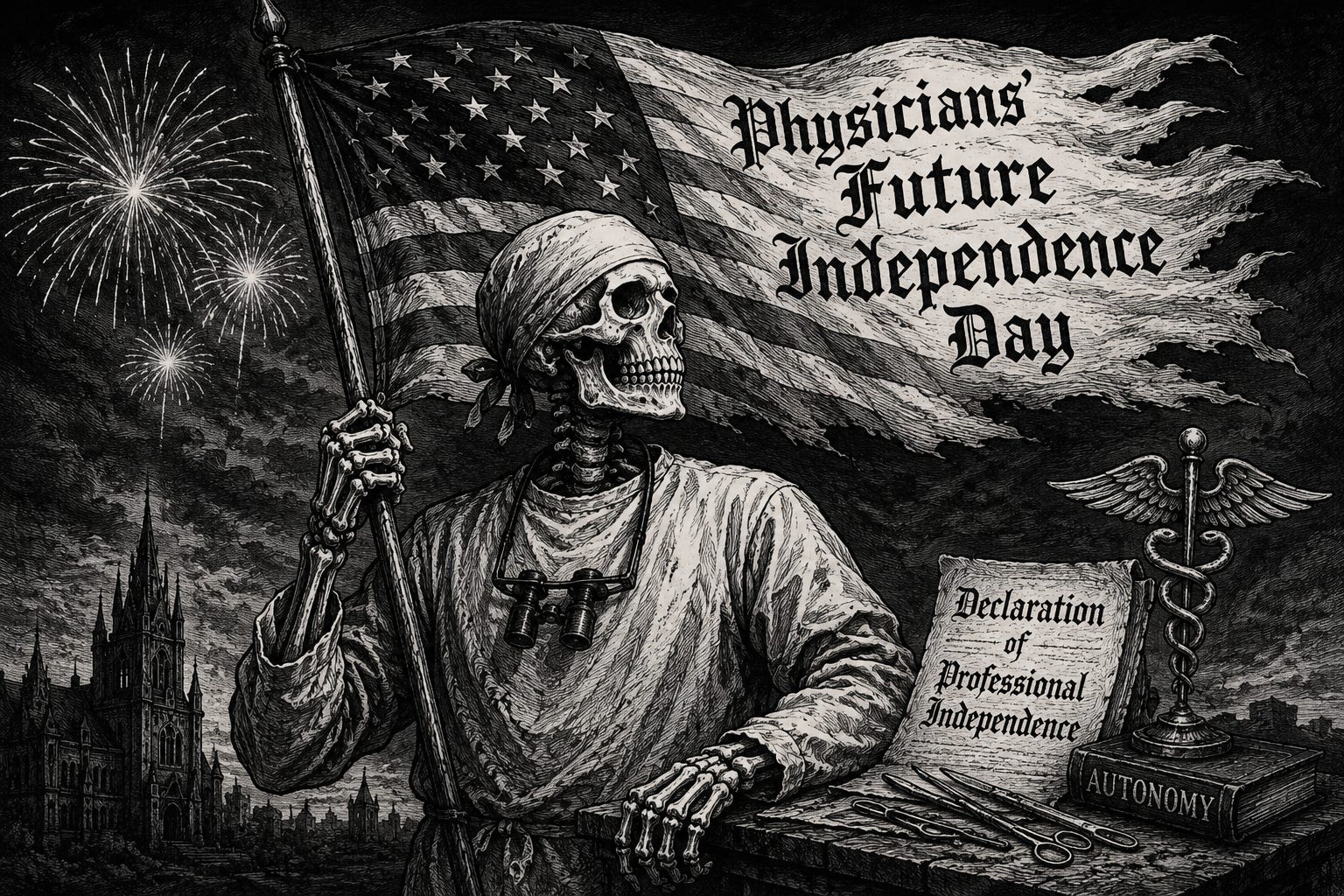
Happy Future Independence Day!

America turns 250 years old today. Birthdays and anniversaries present a wonderful opportunity to reflect on our past and think about our future. We can learn a lot about where we’re headed by studying where we’ve been. A keen eye spots emerging trends and senses shifts in the zeitgeist to predict what tomorrow holds. The previous 250 years shapes the next 250.
Of course, I’m a doctor, not a historian.
If you had to identify the birthdate of modern American healthcare, you’d likely point to either 1929’s Baylor Plan that gave rise to Blue Cross or the WWII-era Stabilization Act that ushered in the era of employer-sponsored health insurance. We’re now squarely in the post-modern era — astronomical expenditure, rising consolidation, and the death of physician independence. While it may seem bleak, if you look hard enough, you begin to see the seeds of healthcare’s next phase.
Call it post-postmodernism, neoclassicism, or metamodernism — the next era of American Healthcare is coming, and with it, a Future Independence Day for doctors.
Here’s why.
Site Neutrality and Site-of-Service
Last week, CMS released its 2027 OPPS rules which expanded site neutral payments to include non-contrast imaging. A similar provision was introduced last year, bringing site neutral payments to drug infusions. Medicare also eliminated the inpatient only list for many surgical procedures, paving the way for more lucrative procedures to migrate to cost-effective ASCs. Earlier in the year, CMMI introduced CJR-X, a value-based care program that goes into effect in October 2027. At that time, every Medicare joint replacement performed in an inpatient setting will fall under a risk-based payment program.
The message is clear: the economics of once lucrative inpatient care, especially for high value joint and spine surgeries, is shifting.
CMS/CMMI will almost certainly continue its march to site neutrality and cost transparency, despite hospital and health system pushback. The effect will trickle down to commercial payers, self-insured employers, and savvy patients, reshaping where care is received, how it’s paid for, and who benefits. The facility fees and massive price variations for the same procedure that drive much of healthcare’s costs will slowly become a thing of the past.
So will the economic case for owning physicians.
Reverse Consolidation
Market forces have created an unprecedented wave of physician consolidation in the post-modern healthcare era. More doctors are employed today than ever. Whether its health systems, private equity firms, or payviders, the last 10-20 years have seen a massive wave of physician group acquisitions. The thesis: control the top of the funnel, control the downstream revenue it creates.
Vertical integration is the gift that keeps on giving, especially when it comes to procedural specialities. Every “owned” total joint generates OR and imaging facility fees, professional fees, skilled nursing facility admissions, home health visits, and outpatient PT referrals. The more of them you own, the more the dollars compound.
The recent shift to office and ASC-based procedures has created a different opportunity for a different set of aggregators. Regulatory tailwinds and advances in surgical techniques and protocols created an opportunity to migrate higher acuity, more lucrative procedures to owned facilities. No longer was it necessary to own inpatient facilities (and manage their complexities) in order to benefit from the revenue these surgeries generate.
Enter private equity and payviders like Optum. The ZIRP-era of low interest rates saw a wave of specialty care acquisitions. That was then, this is now.
These platforms are struggling. Few have experienced exits — the vaunted “second bite.” Most are struggling with debt service as interest rates remain high and top-of-the-market multiples are coming back to haunt them. True integration and clinical governance never materialized, and aggregators learned a hard lesson — managing doctors is like herding cats. (At least cats can be trained to use a litter box).
I suspect we are on the verge of a very painful and very eye-opening reckoning in the PE-backed PPM market, at least in Orthopedics. Few platforms are growing. Several have gone to market but haven’t found any takers. Even continuation funds and recapitalizations have been hard to come by. And interest rates may go up before they come down again.
Walmart, Amazon, CVS, and Big Tech all realized that owning traditional healthcare delivery is a fool’s errand. Private equity firms held on a little longer but are likely now reaching the same conclusion. Even Optum, once viewed as the eventual buyer of many of these platforms, is looking to divest specialty provider groups — including its Ortho practices in New York.
Health systems may reach the same conclusion about physician ownership, too. Joint and spine cases shifting to ASCs is a major hit to revenue. Mandatory VBC brings real downside risk with it and flips vertical integration on its head. Under bundled payments, referring patients to your SNF, PT, or home health services now costs money. Without gainsharing agreements, getting physicians to change their behavior is difficult; but those further eat into your bottom line. The continued march to site neutrality will almost certainly eventually come for HOPDs, and maybe even inpatient facility fees.
That Orthopedic Surgeon that once generated $3M+ in hospital revenue doesn’t look so employable. Anecdotally, some employed surgeons are already seeing changes to their comp models with fewer dollars per RVU. Employment, once viewed as the “safe” path, won’t feel so safe in the future. Doctors will only tolerate a lower ceiling when it comes with a stable floor.
We’re also headed for a reckoning beyond the financial metrics of physician employment. Doctors are becoming less tolerant of the administrative burden, loss of autonomy, and lack of representation that comes with employment. There’s a growing trend of discontentment and move towards unionization. Hospitals and health systems may decide the aggravation isn’t worth it.
Physicians’ Future Independence Day will arise from something very boring and something very apropos for American healthcare: owning physicians simply won’t make financial sense anymore. Not for health systems, not for PE firms, not for payviders. The only physician ownership that will make sense will be physicians owning themselves.
The Future Independent Physician
While the tea leaves point to a renaissance of physician independence, there’s an important caveat: many of the headwinds facing healthcare are ownership agnostic. The conditions that led many physicians to consolidate in the first place haven’t changed. Just because things may be worsening for consolidators doesn’t mean they’re getting better for independent physicians.
Site neutrality doesn’t guarantee a continued upward trend for ASC and office-based payments. Once a new market is established, old reimbursement trends may quickly re-establish themselves, leading to compressed ASC margins. Downward pressure on professional fees is likely to continue, too. Administrative burden and complex “pay for performance” mechanisms may make the specter of independent practice unattractive. To mix metaphors, the brown grass you know is better than the green grass that may not exist.
In short, the future of independent practice will look different than the past out of necessity. That challenge presents an opportunity. Employed physicians are looking for a safe landing spot — if only someone will create it.
That someone could be a national physician-owned MSO or supergroup that provides the infrastructure, negotiating leverage, and economies of scale to support indepedence in the metamodern era. It could be tech-enabled micropractices leveraging AI to reduce costs and offer data-driven quality improvements to make cash pay/direct contracting a reality. Finally, it could be novel joint ventures combining strong physician governance, real clinical leadership, and non-extractive business expertise.
The structure isn’t as important as the end result — a return to independence.
E Pluribus Unum or Ex Uno Plures?
Those who forget history are doomed to repeat it, but we’re in uncharted territory when it comes to physician consolidation and independence. Still, I’m a big believer in cycles. We’ve hit the top of the employment cycle, and it’s only natural that the pendulum should swing back toward independence. This market is long overdue for a correction, and the headwinds and tailwinds are blowing in a different direction.
From many, one — or from one, many?
The future of physician independence will be a little of both. From many physicians, one common goal of supporting each other. From one trend of consolidation, to many paths toward autonomy. Independence in spirit; strength in numbers.
Happy Future Independence Day to my physician colleagues.
BS
Dr. Schwartz: I don’t understand all of the abbreviations. Gerald marti